





How Much Screen Time Should Children Have by Age?
Short answer: The World Health Organization (WHO) does not recommend sedentary screen time for infants or one-year-olds and says no more than one hour a day, less is better, at ages two to four. It gives no daily screen-minute limit for ages five and up in that under-five guideline. For older children, the American Academy of Pediatrics (AAP) asks families to consider the content, context, and what screens may displace, then make a plan that fits the child.
A parent searching for a single number can find different answers because sources cover different ages or aspects of screen use. This guide puts the sources next to each other and then helps you make a rule your family can actually use. It concerns ordinary recreational screen viewing and games, not a medical or educational plan prescribed for your child.
Age-by-age screen-time guide
| Age | WHO guidance | Practical family decision |
|---|---|---|
| Under 1 | Sedentary screen time is not recommended. | Prioritize face-to-face interaction, floor play, songs and books with a caregiver. |
| 1 | Sedentary screen time is not recommended. | Keep a video from becoming the default way to fill a quiet moment. |
| 2–4 | No more than one hour a day; less is better. | Leave room for active play, books and time together; the maximum is not a daily target. |
| 5–12 | The WHO under-five guideline does not cover these ages. | Use a family media plan that accounts for school, sleep, friends, play and the child’s needs. |
The WHO figures come from its 2019 under-five guidance. A ceiling is not a target to fill. If your child has an individualized medical or developmental plan, discuss how general advice applies with their clinician.
Why one number cannot describe every screen moment
The AAP’s 2026 explanation of its updated policy moves beyond simple time limits toward quality, context and conversation. A video watched and discussed with a parent is a different experience from an autoplay feed that is difficult to leave. This does not make duration irrelevant: a screen can crowd out sleep, active play, reading and time together. The AAP specifically suggests shared devices, watching or playing alongside children, and screen-free places such as bedrooms and dining tables.
The WHO guideline also looks at a whole day, not just a stopwatch. It places sedentary screen time beside physical activity and sleep, and encourages reading or storytelling with a caregiver during quiet sitting time. For a child of three or four, the WHO recommends at least 180 minutes of physical activity spread across the day and 10–13 hours of good-quality sleep, including a nap where relevant. These are different kinds of guidance; you do not have to turn every afternoon into a schedule to see whether screens are taking over a useful part of the day.
What should you count?
For a simple family log, record the time your child spends watching television, videos and short clips, or playing screen-based games on a phone, tablet, computer or console. The WHO names TV or video viewing and computer games as examples of sedentary screen time. Educational branding does not erase the viewing minutes; the quality of the content is a separate question.
A video call with a relative is interactive and may matter to family connection. It still involves a screen, so note it separately rather than declaring it either identical to autoplay videos or automatically exempt. Likewise, write down a television playing in the background as a household habit even if you cannot measure how long the child actually watched it. An audio story or podcast with the display off is not time spent looking at a screen; it also does not replace conversation, reading together or active play.
If you want a realistic starting picture, write down three ordinary days: what was on, roughly when it began and ended, whether an adult joined in, and what happened before bed. Do not turn the notes into a score for your child. The aim is to find one change that would help your household.
Make a rule you can keep this week
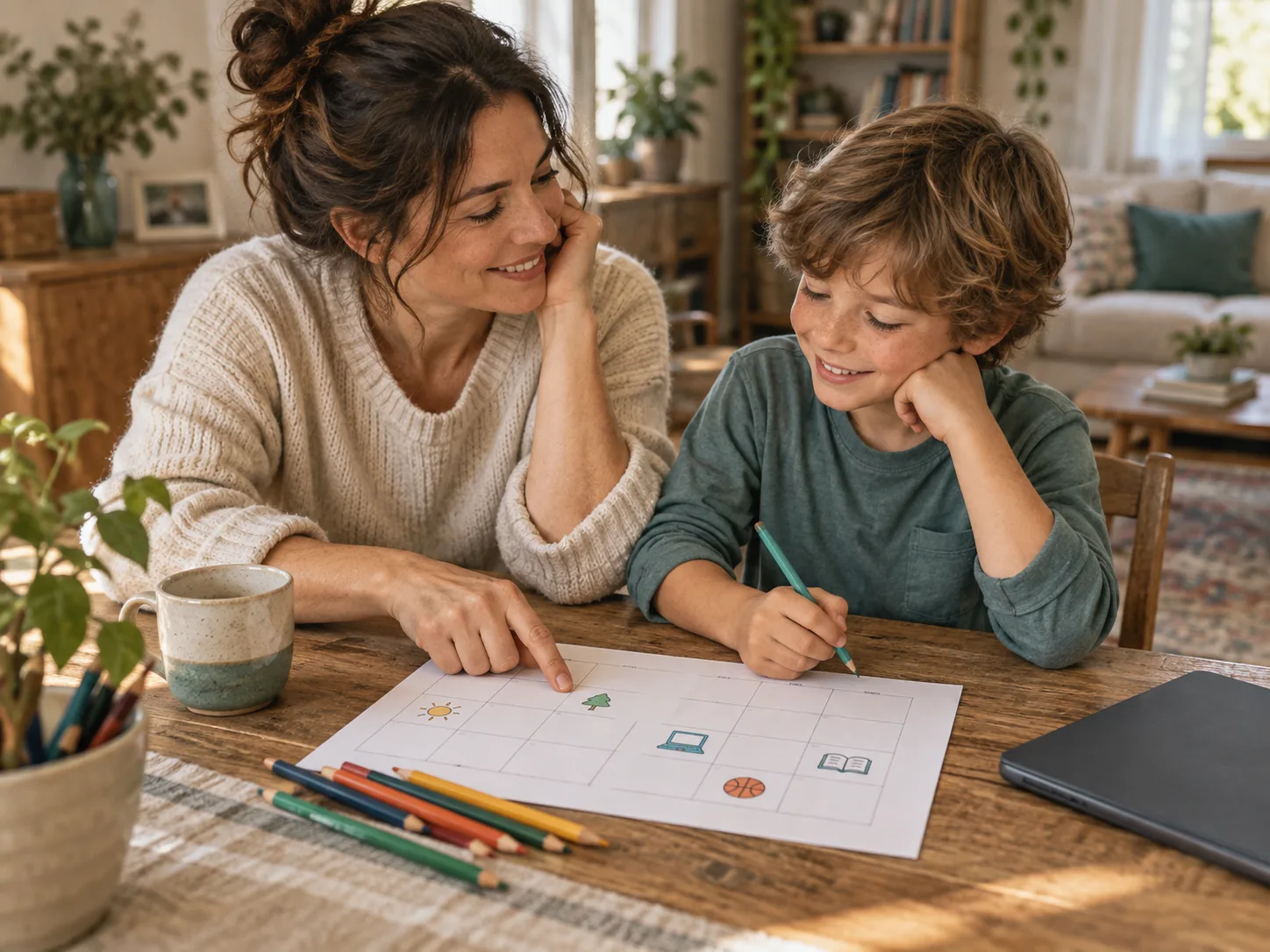
The AAP’s Family Media Plan guide suggests agreeing on screen-free places and times, turning off autoplay and notifications, choosing suitable content and leaving room for other activities. Try a short version on paper:
- Choose the time and place. For example: one program in the living room after afternoon play. Keep meals and the bedtime routine screen-free.
- Choose together, before pressing play. Check the program, game or app for your child’s age, ads and automatic next episodes.
- Name the ending. “After this episode, the screen goes on the shelf. Then we’ll set the table.” An ending tied to a real event is easier to understand than an unexplained number.
- Plan the next activity. Put a book, blocks or drawing materials where the child can reach them. An audio story with the screen off may be another option for a child who likes listening; Blub Podcasts, for ages 4–9, is one example.
- Use the rule yourself. Adults can put phones away at the meal, too. Revisit the plan after a week if it does not fit school days, work or the child’s needs.
For a three-year-old, keep the choices small: “One short program now, then we draw.” A ten-year-old can help decide which game fits the available time and what to do about notifications. The limit itself remains an adult responsibility. If screen time ends in a difficult transition, see the more focused guide on what to do when a child struggles to stop.
If the plan is not working
A child may protest even when the rule is clear. Stay with the boundary without treating disappointment as proof of a disorder. If the same conflict repeats, look for a practical obstacle: a game that cannot be paused, a reminder delivered too late, tiredness, or nothing appealing to do next. Change one part of the plan and try again. A child who needs extra support with transitions may need a picture sequence, shorter sessions or advice tailored to them.
Pay attention to the broader picture rather than diagnosing “screen addiction” from minutes alone. If screen use regularly interferes with sleep, school, relationships or everyday functioning, bring specific observations to your child’s pediatrician. The AAP’s 2026 guide discusses the effects of problematic media use and recommends support when families need it. General advice cannot tell you the cause of one child’s difficulties.
The decision to take away
For under-fives, follow the WHO age-specific guidance; do not copy a number from one age to another. For school-age children, protect sleep, movement, schoolwork and relationships while choosing content and limits with them. A useful family rule is one you can explain, follow, and revise—not a minute total that looks tidy on paper but ignores the rest of the day.
Sources
- World Health Organization: To grow up healthy, children need to sit less and play more (2019)
- American Academy of Pediatrics: Helping Kids Thrive in a Digital World (2026)
- American Academy of Pediatrics: How to Make a Family Media Plan (2026)
This article is for general information and isn’t medical advice. If you’re worried about your child, talk to your pediatrician.

Blub Editorial Team
The Blub Editorial Team is the team behind Blub Kids’ science podcasts for children. We base our articles on WHO, AAP and other primary sources, and we check AI-assisted drafts against those sources before publishing. We don’t give medical advice.
How we write our guides →

