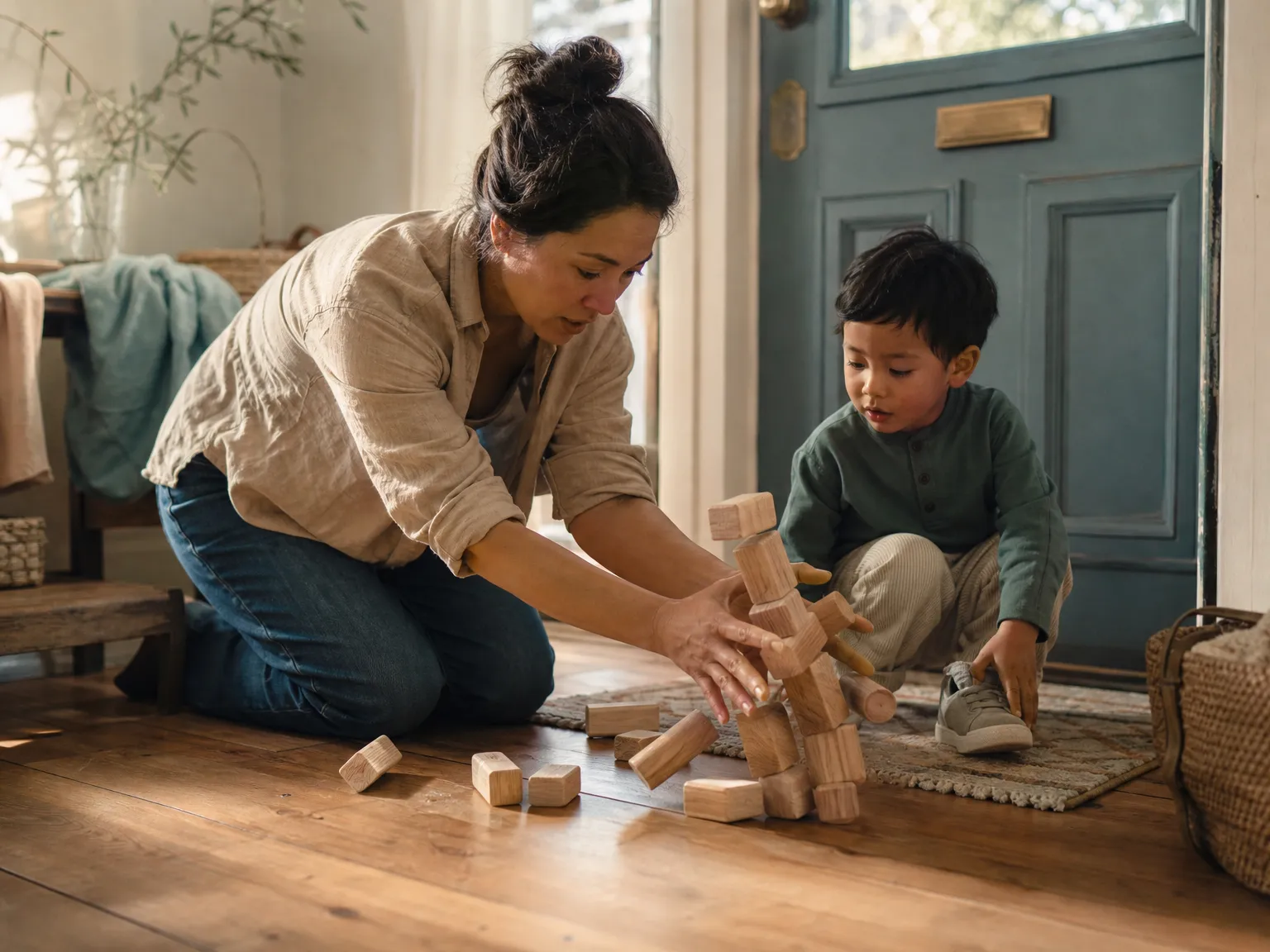
Cleaning Up Toys Becomes a Fight: How Can We Share the Task?

Short answer: Choose one small cleanup job for your child and work alongside them. Say who will put away each group of toys, keeping the jobs appropriate for your child’s age. Make the cleanup point predictable; if your child refuses, make the first job smaller and find out what is getting in the way.
This guide is for ordinary toy cleanup with children roughly ages 2–10. A toddler may carry a few large toys to a basket while an adult handles the rest; a school-age child can take responsibility for a defined part of the space. The goal is a fair way to work together, not a perfectly tidy room or a promise that your child will always agree. If you need to remove a sharp, broken, or otherwise unsafe object, handle that yourself first.
Decide what “done” means before asking
“Clean your room” can mean something quite different to a child staring at a floor full of blocks, books, costumes, and half-built projects. Pick the immediate need: perhaps the walking path must be clear before dinner, or toys must be off the bed before sleep. A tower that can safely stay on a shelf need not be dismantled just because other toys need putting away. Say the destination as well as the job: “Blocks go in this basket; books go on that shelf.”
The American Academy of Pediatrics (AAP) recommends spelling out chores clearly, introducing one new task at a time for school-age children, and keeping expectations realistic. For a young child, an adult can show the route by putting one block in the basket together. This is teaching a household routine, not testing whether the child understood an entire room-sized instruction.
Use containers your child can reach and recognize. If putting a toy away requires an adult to climb, sort many tiny pieces, or force a lid shut, assign that part to the adult. A basket and a shelf are enough; you do not need a new organizing system to try this tonight. Put any small parts or damaged toys out of reach of children for whom they are unsafe.
Make the split explicit
A shared task works best when each person knows their part. You might say, “You put the blocks in the basket. I’ll put the books on the shelf. Then we’ll look at the floor together.” If there are two children, give each a concrete, manageable category or area rather than saying, “Both of you clean this up.” Rotate jobs over time so one child does not always get the longest or least pleasant one. Stay nearby to help a younger child finish; giving a job does not mean leaving them alone with it.
This division also gives the adult a real share. UNICEF’s guidance on household work says tasks should suit children’s ages, some jobs remain adults’ responsibility, and boys and girls should have equal opportunities to help. If siblings differ in age or ability, “fair” need not mean an identical number of toys. It can mean each child has a job they can actually do, with adults handling the parts that require them. Check that cleanup does not routinely fall to one child because of gender or birth order.
If one child made most of the mess and another played only briefly, acknowledge that difference when dividing the job. You can still ask everyone who used the shared space to help with one piece of restoring it. Discuss the arrangement at a calm time, then adjust it if one job keeps taking much longer. The point is a workable agreement, not a courtroom account of who touched each toy.
Try one cleanup round tonight
Choose a natural stopping point, such as before the next activity or before the evening routine. Allow a little room to finish a play idea: “When this track reaches the station, we’ll put the trains away before dinner.” A predictable cue can help your child know what comes next, but a warning alone does not do the work.
If stopping the game is the hardest part of this moment, our guide to leaving an unfinished game offers more ways to mark a pause. Here, keep the focus on who will put away which toys once play stops.
- Name the shared goal. “We need a clear path to the table.” Point to the area, rather than demanding that every corner of the room be perfect.
- Give one job each. “Your job is the large blocks. My job is the books.” Show where both belong. For a young child, begin with just one or two items.
- Work at the same time. Put away your own category while your child does theirs. If they pause, return to the next visible item: “Here’s a block by your foot. Where does it go?”
- Check together. Ask, “Can we walk to the table safely now?” If not, name one remaining action. Notice the specific contribution: “You put the blocks where we can find them tomorrow.”
A possible exchange sounds like this:
Parent: “Dinner is next. The blocks need to go in the basket. I’ll stack the books.”
Child: “I don’t want to. I was making a city.”
Parent: “You wanted to keep the city. Let’s leave the one building on the shelf if it fits safely. Please put these loose blocks in the basket. I’ll start with the books beside you.”
Child: “Just this building?”
Parent: “Yes. The loose blocks go away, and we can look at the building tomorrow.”
That compromise fits some games, not every home or safety situation. If the floor must be clear or pieces are unsafe to leave out, explain that limit plainly. The AAP’s advice for parents of 4–6-year-olds describes routines and supported household responsibilities, including putting toys away. It does not require a preschooler to manage the whole process independently.
Change the job with the child’s age
Around 2–3: Treat cleanup as a short joint action. Hold the basket steady, point to one large toy, and let your child carry or drop it in. You may do most of the work. Keep small parts and heavy storage out of their job. There is no need to turn a toddler’s unfinished handful of toys into a contest.
Around 4–6: Give one category and its destination: “Put the cars in the low box.” Stay present while they learn the sequence, then ask what comes next. The AAP’s guide for ages 4–6 names putting toys away as a growing responsibility with adult support. A child this age may still need help shifting away from play.
Around 7–10: Agree on a defined area or a short list before cleanup begins. The AAP includes putting toys away among chores for ages 5–7 and recommends clear expectations, routines, and family discussion as children take on more responsibilities. Ask an older child which category they will own, then let them show you whether the agreed area is ready. If they have a more practical place for a toy, consider their suggestion.
These are starting points, not ability tests. A child with a disability, a child who finds transitions hard, or a child who is exhausted may need a smaller job, a picture of where things go, or hands-on help. The AAP notes that children differ in organization and in moving from one activity to another; adjust the task to the child in front of you.
If your child refuses or the argument starts again
Pause the repeated commands. First check whether the request was clear and possible. Is the basket full? Does your child know where the pieces belong? Are they upset about stopping a game, or tired after a long day? Ask one question later if the moment is too heated: “What was hardest about putting the toys away?” Then change one thing you can observe, such as the time, the size of the job, or the storage place.
In the moment, keep the necessary boundary small: “The path needs to be clear. I’ll hold the basket; please put these three blocks in.” If they still will not join, calmly clear what is needed for safety and carry on with the next family need. Revisit the shared job when everyone is settled. Avoid turning cleanup into a prolonged lecture or assuming one refusal means the child is unwilling to help at all. The AAP advises encouragement and guidance rather than nagging or scolding, and warns that oversized chores can overwhelm children.
If the same fight repeats, try asking your child to choose which of two acceptable jobs to take: “Blocks or cars?” Keep the adult’s part visible too. A child who declines both may need you to do the first item with them; an older child may be ready to renegotiate the division at a calm family check-in. Do not promise a reward or threaten to throw toys away merely to get through one evening. Make the cleanup plan something your family can repeat without a bigger battle attached to it.
If difficulty with ordinary responsibilities is persistent across home and school despite reasonable support, or if distress and conflict are intense and frequent, discuss the pattern with your child’s pediatrician or another appropriate professional. The AAP specifically suggests raising ongoing problems with responsibilities when they also occur at school. One toy-cleanup argument on its own does not establish a developmental or behavioral condition.
For the next cleanup, pick the one area that truly needs clearing, give your child one reachable category, and take another category yourself. When the first round is done, decide together whether anything else actually needs moving. The useful question is “Which part can each of us do?” rather than “Who made this mess?”
Sources
- American Academy of Pediatrics, “Age-Appropriate Chores for Children” — age-based chores, clear and realistic expectations, routines, encouragement, and when to ask a pediatrician.
- American Academy of Pediatrics, “Growing Independence: Tips for Parents of Young Children” — ages 4–6, supported responsibility, toy cleanup, and routines.
- UNICEF, “Four key ways to promote equity in household tasks” — sharing age-appropriate work fairly, adult roles, and protecting children’s time for play and learning.

Blub Editorial Team
The Blub Editorial Team is the team behind Blub Kids’ science podcasts for children. We base our articles on WHO, AAP and other primary sources, and we check AI-assisted drafts against those sources before publishing. We don’t give medical advice.
How we write our guides →