





My Kids Keep Fighting: When Should I Step In?
Short answer: Step in immediately if there is hitting, threats, intimidation, or a child cannot protect themselves. Make everyone safe first. If the children are having a safe, ordinary disagreement and are old enough to talk it through, give them a brief chance to find a solution. Join as a calm guide if the conflict escalates or they get stuck. Your job is to protect both children and help them practice a better way to disagree, not to declare a winner in every argument.
It can feel as though the referee whistle is permanently in your hand. Yet a dispute about whose turn it is and a child being frightened by a stronger sibling call for different responses. The American Academy of Pediatrics (AAP) advises letting children try to resolve simple disagreements, while stepping in when their physical or emotional well-being is at risk or they cannot reach a resolution. Younger children need more adult help with this than older ones. This guide focuses on everyday sibling conflicts for families with children roughly ages 2–12; it is not a stopwatch for how long to let an argument run.
A three-question decision check
Is anyone unsafe? Do not wait through hitting, kicking, thrown objects, threats, or a clear power imbalance. Separate the children safely, move dangerous objects, and get medical help for an injury when needed. “Let them sort it out” does not apply to danger.
Can both children have a say? If one child is consistently silenced, frightened, trapped, or ignored after saying “stop,” the adult needs to intervene. Emotional safety matters as well as physical safety. The AAP explicitly includes concern for a child’s emotional well-being as a reason to step in.
Are they moving toward a solution? “You use it first, then me” is a sign you can stay nearby and let them try. If they repeat the same accusations and grow louder, slow the exchange down. UNICEF Uruguay describes the adult as a guide rather than a judge and emphasizes modeling nonviolent problem-solving.
These questions are a reminder for a stressful moment, not a clinical test. If a child looks afraid, act without waiting for the third answer.
What giving them room actually looks like
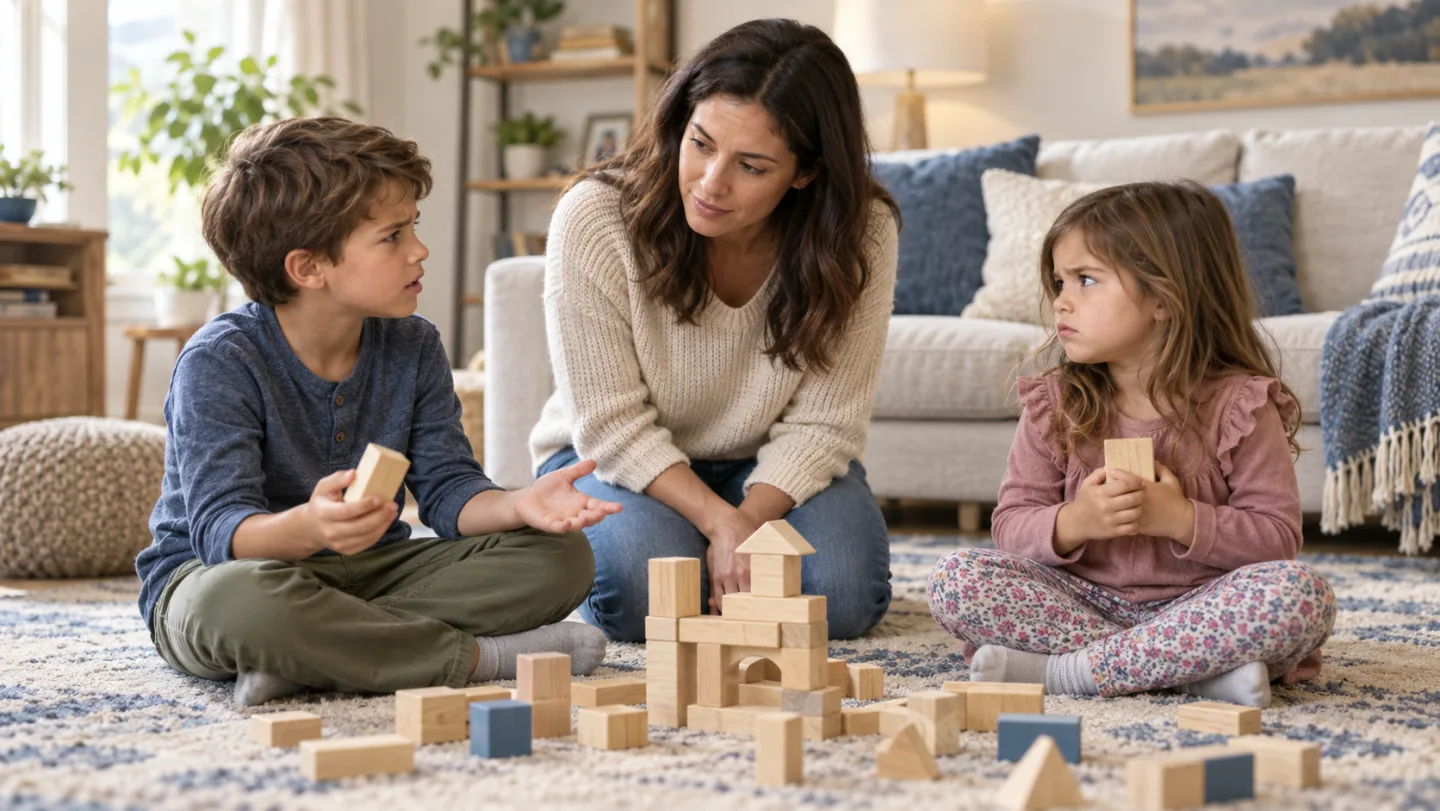
Imagine two children reaching for the same box of blocks. Both keep their hands to themselves and both can speak. Stay close and say, “I hear that you both want the blocks. What could work for both of you?” Then leave a little space for answers. Taking turns, dividing pieces, or building together might work; invite the children to propose and choose. If they cannot, you can help them decide.
Giving room does not mean leaving young children unsupervised. Toddlers may need the same short rule repeated many times. The AAP notes that parents generally intervene more often with young siblings and can reduce their role as children mature. Agree on simple rules outside the heat of an argument: no hitting, stop when someone says stop, and ask before going into another person’s room. A rule that everyone already knows is easier to use than a new lecture mid-fight.
The result does not have to be “share everything.” A child may have a personal item they do not want to lend. Listen to that boundary. Fairness does not mean the older child must always give in. UNICEF specifically warns against routinely making the older sibling yield to the younger one.
If you step in, use four moves
1. Stop the unsafe behavior and make room to cool down. “Stop. I won’t let anyone hit. Let’s move apart for a moment.” Keep your voice low and your words short. Separate the children safely if there has been physical contact. A long explanation can wait until they can hear it.
2. Listen to each child. Ask, “What happened from your point of view?” and “What do you need now?” If you missed the start, do not pretend to know who began it. Listening does not excuse harmful behavior. Cleveland Clinic recommends hearing both perspectives instead of starting with blame.
3. Separate feelings from the boundary. “You can be angry. You cannot push. You both wanted the same toy.” If one child frightened the other, check on the hurt child’s safety first. Avoid a blanket “you were both equally wrong” when the behaviors were not equal.
4. Help them choose the next workable action. “Will you take turns, play together, or play separately for now?” Keep the choices realistic. If they cannot agree, set a temporary adult boundary: “The blocks will rest here until we’re ready to try again.” Instead of demanding an instant apology, ask later, “What could help repair this?” UNICEF advises against forcing forgiveness or an apology before a child is ready.
For example, if an older child grabbed a younger child’s construction, protect the younger child and stop the grabbing. Later, listen to both: perhaps the older child did not want their work knocked down. The solution may be a protected building space and a separate set of blocks, not a verdict that one child is simply “bad.” This is an example to try, not a promise that one conversation will end all fights.
Adjust your help to their ages
Ages 2–4: Expect to stay close. Use short sentences and a visible turn: “Mia places two pieces, then you do.” Little children often need an adult to carry out the plan, not just suggest it.
Ages 5–8: Give each child a turn to speak and ask for one idea from each. “What’s a plan you can both accept?” If they cannot agree or tempers rise, you still set the limit.
Ages 9–12: Arguments may be about privacy, borrowed belongings, or personal space rather than a toy. Help them agree on rules such as knocking before entering a bedroom. Hear each child’s account separately when needed.
Age is only one part of the picture. A child with communication or developmental differences may need clearer visual cues and more adult support. Do not make independence a rigid requirement.
When the same fight keeps returning
Later, when everyone is calm, look for a pattern. Does the fight begin when children are tired, a shared device runs out of charge, or one child needs your attention? Change one condition rather than giving a speech after every incident. You might set a turn-taking plan for a shared tablet, provide a quiet place to be alone, or protect a small amount of one-on-one time with each child. The AAP and Cleveland Clinic both encourage individual attention, avoiding comparisons, and opportunities for cooperation. A cooperative board game or shared building challenge can be practice, but it need not be a reward for “being friends.”
If conflict increased after a baby joined the family, our guide to preparing a child for a new sibling offers ways to explain changes and protect individual time. Do not assume the baby explains every dispute.
When to ask for more support
Speak with your child’s pediatrician if one child is regularly afraid of the other, physical attacks or threats recur, or conflict significantly affects sleep, school, friendships, or family life. Cleveland Clinic recommends professional help when safety is a concern, daily functioning is affected, or home efforts are not helping. Seek local emergency help for immediate danger. Frequent arguing alone is not a diagnosis; a professional can help assess the children’s needs and safety.
The goal for today is modest: stop danger, allow some room for a safe disagreement, and join in calmly when children need help finding a next step.
Sources
- American Academy of Pediatrics: Sibling relationships and when to intervene — age-aware support, room for simple disagreements, and stepping in for physical or emotional concerns.
- UNICEF Uruguay: Preventing and managing sibling fights — calm guidance, avoiding comparisons and forced forgiveness.
- Cleveland Clinic: Dealing with sibling rivalry — listening, family rules, one-on-one time, and signs to seek professional help.

Blub Editorial Team
The Blub Editorial Team is the team behind Blub Kids’ science podcasts for children. We base our articles on WHO, AAP and other primary sources, and we check AI-assisted drafts against those sources before publishing. We don’t give medical advice.
How we write our guides →

