





My Child Wants to Quit a Sport: Should I Insist?
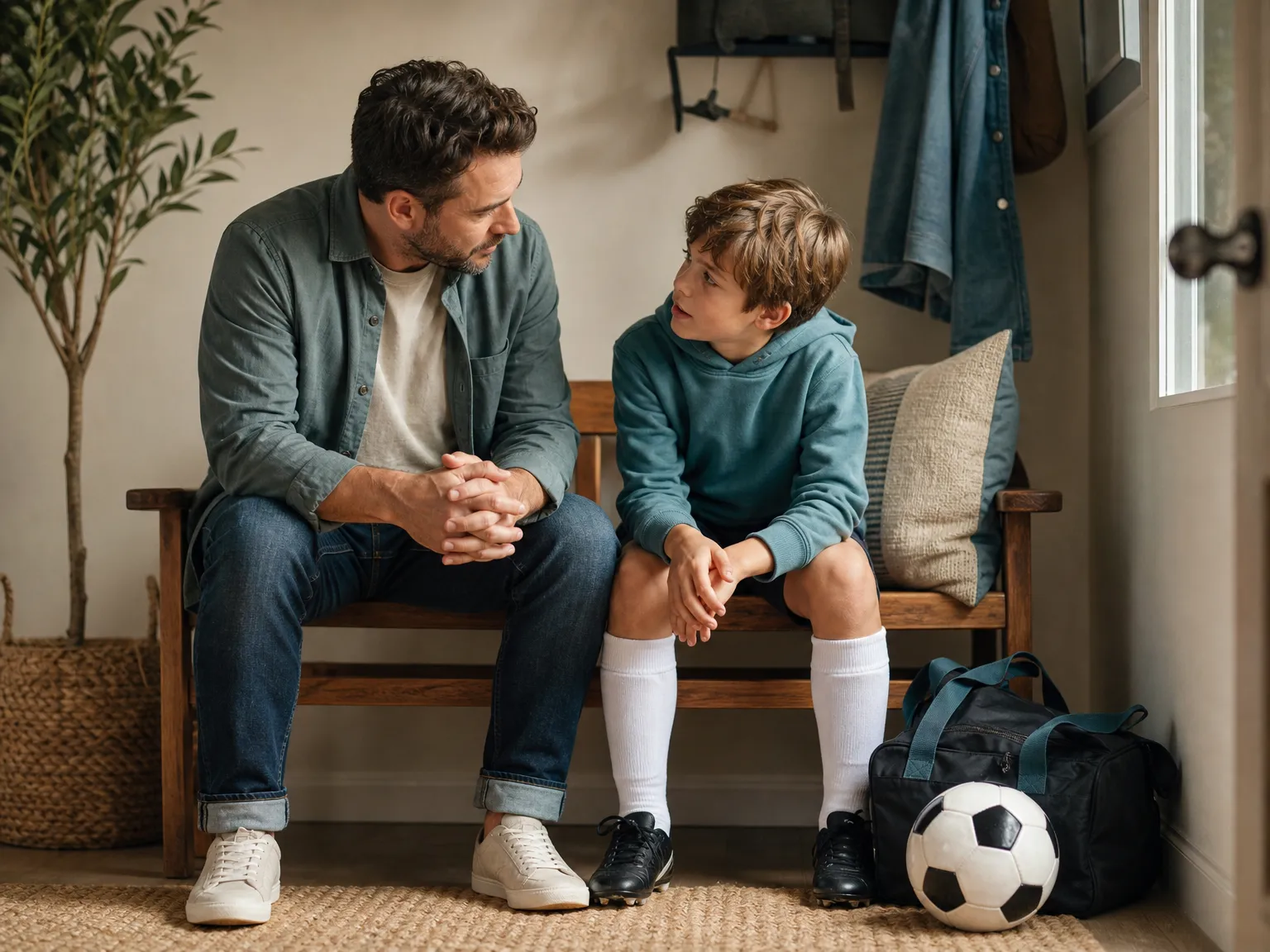
Short answer: Listen before insisting: find out whether your child wants to leave the sport, the team, or a particular uncomfortable situation. If the setting is safe and your child is willing, agree on one practical change and a short trial before deciding. Pain, mistreatment, or overwhelming distress calls for a pause and adult help, not a lesson in sticking it out.
The sports bag is by the door, practice starts soon, and your child says, “I’m not going. I hate soccer.” You may worry that allowing them to stop will teach them to give up whenever something gets hard. You may also wonder whether you have missed something important.
For parents of children roughly ages 5–12, the useful question is: What would we be asking our child to persist through? Learning a difficult skill, being repeatedly humiliated, and attending a sport they no longer enjoy are different problems. They need different responses.
First, find out what “I want to quit” means
The American Academy of Pediatrics’ school-age sports guidance recommends finding out the reasons, listening, and deciding together. It acknowledges that leaving a program can sometimes be the sensible choice. This is not a rule that every child should stop after a bad session—or finish every season regardless of circumstances.
Start with a safety check: “Are you hurt? Did anyone do something that made you feel unsafe?” If there is no immediate concern, save the longer conversation for a quiet moment away from the practice deadline. You do not need to settle the whole season while searching for shin guards.
Try one question at a time:
- “Which part do you wish you could skip?”
- “Was something different today, or have you felt this way for a while?”
- “If you could change one thing about practice, what would it be?”
- “Would you still want to play with a different group?”
Listen for specifics before suggesting solutions. “It’s boring” might mean waiting on the sidelines, repeating skills that feel too easy, or not wanting this activity anymore. “I’m bad at it” might refer to one missed shot or repeated criticism. Neither phrase tells you the whole story.
Choose a response that matches the problem
Use this as a conversation aid, not a diagnostic checklist:
| What you learn | A useful next step |
|---|---|
| Your child still likes the sport but feels stuck on a skill | Ask whether they want help with that skill and discuss a manageable practice goal with the coach. |
| Practices crowd out rest, homework, or ordinary play | Review the schedule and ask whether fewer sessions or a less demanding program is possible. |
| They like playing but dislike the team’s atmosphere | Look into the concern and consider a different coach, group, or recreational setting. |
| Interest has faded, even when the setting is welcoming | Discuss leaving and other enjoyable ways to stay active. |
| They report pain, threats, humiliation, or feeling unsafe | Pause participation while you arrange appropriate help and address safety. |
Nemours KidsHealth’s guidance on competitive sports identifies pressure to win, an overloaded schedule, and not wanting to play as possible sources of stress. Its suggestions include focusing on effort, reducing demands, and making decisions together. A different timetable or atmosphere may be worth exploring before treating the child as the problem.
If they are willing, agree on one change and a review point
A trial makes sense when your child wants something about the activity to work and there is no unresolved safety concern. It should test a specific change, rather than require more of the same until they stop complaining.
- Name the difficulty together. “You like games, but during drills you don’t understand what to do.”
- Choose one change. Ask the coach to demonstrate the drill before your child joins, for example. Check that the coach can actually offer this support.
- Agree when to talk again. You might choose after the next two practices. That is a family planning example, not an evidence-based minimum or a promise that two sessions will solve the problem.
- Define what you will notice. Ask whether your child understood the instructions, felt treated kindly, and wanted to join any part of practice. Winning is not the test.
- Keep the review honest. If the change did not happen or the experience remains miserable, consider another setting, a break, or leaving. Do not keep extending the agreement automatically.
A conversation might sound like this:
Child: “I’m quitting. Everyone can do it except me.”
Parent: “It felt awful being stuck. Is it the drill you want to stop, or soccer altogether?”
Child: “I like the games. I don’t know where to run.”
Parent: “Would you like me to ask the coach to walk through it with you? We could try that and talk after Saturday. If anyone is unkind or you feel unsafe, tell me sooner.”
If your child says no, hear that answer too. Ask what feels wrong about the plan rather than turning the trial into a test of obedience.
Match expectations to age and readiness
The AAP’s sports-readiness guidance stresses that children develop at different rates. Age bands are starting points, not a verdict on an individual child’s ability.
Around age 5: Most children under 6 are not yet ready for the demands of organized sports. Favor playful running, throwing, catching, and other basic movement, with simple demonstrations and little formal instruction. Stepping away from a structured team can be a change in format; it does not have to mean stopping active play.
Ages 6–9: Look for adapted rules, suitable equipment, opportunities to participate, and an emphasis on learning. A child who struggles with complex instructions may need a simpler version of the activity. Ask what the program expects before insisting that the child adjust to it.
Ages 10–12: Give your child a substantial voice in the choice of activity and level of commitment. The AAP notes that differences in physical maturity can affect the sporting experience at this age. Discuss whether the group is a good fit, without using size, speed, or a temporary difficulty as a label for talent.
What if they will not explain?
Avoid repeated questioning. Say, “You don’t have to explain everything now. You can tell me later, write it down, or talk while we take a walk.” Offer a small starting point: “Is it mostly the activity, the people, or how tired you feel?” Allow “something else” and “I don’t know.”
You can also ask the coach factual questions about recent changes, participation, or conflict. Tell your child what you plan to discuss, and avoid arranging a confrontation in front of teammates. If the coach is the source of the concern, contact the club’s manager or safeguarding contact instead. The AAP explicitly advises avoiding abusive coaches.
Silence does not prove either that nothing is wrong or that something serious happened. If your child remains very distressed, pause and seek help rather than requiring a detailed explanation as the price of being heard.
Can leaving still include responsibility?
Yes. Where it is safe and manageable, help your child tell the coach, return borrowed equipment, and thank someone who helped them. Younger children may need you to handle the conversation; older children can choose a sentence to say or write.
You can acknowledge team commitments without using guilt: “Other people planned around us, so we’ll let them know clearly.” Money already spent is an adult concern to manage, not a reason to ignore pain or mistreatment. Before the next enrollment, discuss the schedule and how you will review the fit.
Ask, “What kind of moving would you enjoy now?” Possibilities include informal ball games, dancing at home, or family walks. There is no need to sign up for another team immediately.
When to get extra help
If your child reports pain or an injury, stop the painful activity and seek medical advice before asking them to continue. Do not assume a physical complaint is an excuse because it appears on practice days.
For distress that persists, feels overwhelming, or affects life beyond sport, speak with your child’s pediatrician or a qualified child mental health professional. Nemours’ childhood stress guidance recommends professional support when chronic or traumatic stress needs more help than a parent can provide alone. You do not have to diagnose burnout or anxiety before asking for advice.
For today’s decision, aim to learn what needs to change. Sometimes that will be support with a challenge; sometimes it will be the schedule, the team, or the decision to keep playing.
Sources
- American Academy of Pediatrics: Commonly Asked Sports Questions — school-age guidance on wanting to quit, listening, sports stress, and abusive coaching.
- American Academy of Pediatrics: Is Your Child Ready for Sports? — age-specific readiness, adapted programs, physical maturity, and safety.
- Nemours KidsHealth: Competitive Sports: Helping Kids Play it Cool — pressure, scheduling, enjoyment, and shared decisions about stopping.
- Nemours KidsHealth: Childhood Stress: How Parents Can Help — listening, protection from harmful stress, and seeking professional support.

Blub Editorial Team
The Blub Editorial Team is the team behind Blub Kids’ science podcasts for children. We base our articles on WHO, AAP and other primary sources, and we check AI-assisted drafts against those sources before publishing. We don’t give medical advice.
How we write our guides →

