





My Child Says They Are Being Bullied: What Should I Do First?
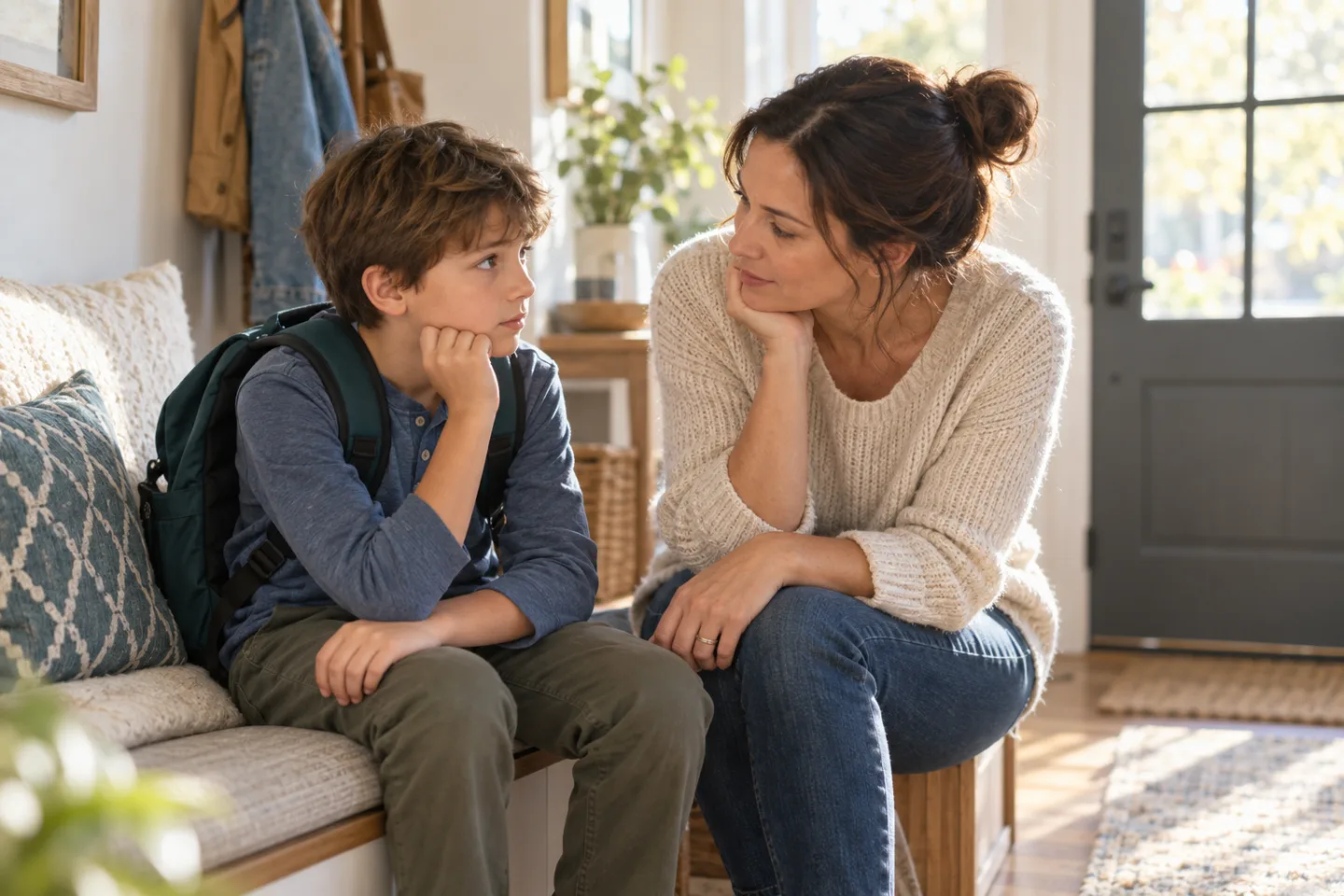
Short answer: Thank your child for telling you, listen calmly, and say that being hurt or humiliated is not their fault. Check whether they are safe now, then agree on which trusted adult will help and contact the school when the incidents involve school life. Your child should help shape the plan, but adults are responsible for protection; immediate danger needs urgent help.
This guide is for parents of children roughly ages 5–12. It focuses on the first conversation and the next school day, rather than asking a child to solve bullying alone. For preschool children, involve the supervising adult directly and use simple descriptions of what happened instead of expecting the child to explain a pattern.
Start by making it safe to tell you
You may want to demand names or call the school immediately. First, let your child finish. The American Academy of Pediatrics (AAP) recommends listening without judgment and recognizes that embarrassment or shame can make children reluctant to share.
An opening might sound like this:
“I’m glad you told me. You don’t deserve to be treated that way. Tell me what happened, and we’ll work out what help you need.”
Then ask one question at a time:
- “What happened most recently?”
- “Where were you, and who was there?”
- “Has something like this happened before?”
- “What are you worried might happen next?”
- “Did an adult see it, or have you told anyone?”
Avoid “Why didn’t you stand up for yourself?” or “What did you do to upset them?” You can gather context without making your child defend their reaction. If they froze, cried, or said nothing, the next step is still adult support.
Don’t promise complete secrecy. Try: “I’ll tell you who I need to speak to and why. I need to get help if you’re unsafe.”
Check safety before sorting out the label
Ask whether your child is hurt, has been threatened, or fears an encounter on the journey to school or during the next school day. Deal with injuries and immediate danger before gathering a full account. If there is an immediate risk of your child harming themselves or someone else, get urgent help; StopBullying.gov explicitly advises immediate help in that situation. Stay with your child and contact local emergency services if you cannot keep them safe.
Bullying in children can involve physical harm, repeated insults, social exclusion, or online attacks. The AAP describes these forms and the role of power. A child might say “They’re bullying me” about different kinds of hurtful experiences. You do not need to settle the terminology before responding to harm.
As StopBullying.gov explains, behaviors that resemble bullying can be just as serious while needing different responses. Tell the school what your child reports: “They hid my bag three times and threatened me when I asked for it,” rather than relying only on “My child is being bullied.”
Turn the account into a small, usable record
After listening, write a short note together, if your child is willing. This is a practical way to prepare for the school conversation, not a requirement for your child to prove they deserve help.
Record the date or approximate time, place, what was said or done, who may have seen it, and any adult already told. Keep your child’s wording where possible. Separate what they reported from what you observed, such as an injury or damaged belongings. Mark unknown details as unknown.
If the incident happened in a game, message thread, or group chat, include that setting in your report. For online incidents, StopBullying.gov advises keeping dates, messages, and screenshots rather than replying to or forwarding hurtful posts. Keep this evidence private when sharing it with the responsible school or platform contact. Do not turn your child’s disclosure into a public parent-group discussion.
Contact the school with a specific request
For incidents involving school, start with the teacher or the school’s designated reporting contact. If there is an urgent safety concern, make that clear at the start and ask for a plan before the next exposure. UNICEF recommends checking the school’s bullying policy, allowing the school to take responsibility, and involving its counselor where available.
Here is a message you can adapt:
“My child has told me that other children have been hiding their bag and threatening them near the playground gate. They described incidents on Monday and Wednesday and are frightened about tomorrow. Please help establish what happened and arrange a safety plan. Who can they go to immediately, how will that area be supervised, and when can we review whether the plan is working?”
Useful questions for the conversation include:
- Who is your child’s named contact, and who is the backup if that person is absent?
- What will adults do in the location where the incidents happen?
- How can your child report another incident privately?
- How will staff watch for retaliation after the report?
- When will you receive an update?
These are planning prompts, not a guarantee of a particular school procedure. Agree on a follow-up date and briefly confirm the plan in writing. For a club, camp, or sports setting, contact the responsible leader instead.
Give your child a plan they can actually use
Keep the child’s part small: where to go, whom to tell, and what to say. The AAP suggests practicing a stop–walk–talk response. Treat the words as an option when safe, never a condition for receiving help. A child facing danger can go straight to an adult.
Try a short rehearsal:
Parent: “If it happens near the gate again, where will you go?”
Child: “To the teacher by the door.”
Parent: “You could say, ‘I need help. They’re threatening me again.’ If that teacher isn’t there, let’s check who your other adult is.”
Do not make fighting back part of the plan. The goal is access to safety and adult help, not a performance of confidence.
For ages 5–7, use one adult’s name, one place, and one short sentence. Ask staff to check in proactively rather than relying entirely on the child to initiate a report.
For ages 8–12, invite more input: “Would you rather talk to your teacher with me, or have me send the message first?” Ask about online spaces too. These age bands are practical adaptations, not developmental cutoffs; adjust for your child’s communication and support needs. A written note, picture, or agreed signal can be an alternative to speaking under pressure.
If your child shuts down or says “Don’t tell anyone”
You do not need the whole story in one sitting. The AAP advises letting children know they can talk when ready. Offer a quieter moment, a note, or another trusted adult.
Ask what they fear will happen if someone is told. Then be honest: “I hear that you’re worried they’ll make things worse. We need to tell the teacher about that worry too. You can help me choose how to explain it.”
Respecting their pace does not mean leaving a known danger unaddressed. Share the safety concern with the responsible adult even if your child cannot yet give every detail.
Follow up, and know when more help is needed
At the agreed check-in, ask about the plan: “Could you find your adult?” and “Did anything happen in that spot today?” If incidents continue or the response is inadequate, take the written record to the principal or next contact in the school’s complaints process. Ask for revised protective steps. A report is the beginning of follow-up, not proof that the problem has stopped.
Contact your child’s pediatrician or a qualified mental health professional when distress persists or affects daily life. The AAP lists school avoidance, sleep or eating changes, headaches, stomachaches, social withdrawal, and self-harm among possible warning signs, while noting that these can have other causes. Do not assume bullying explains every symptom or wait for the school investigation to finish before seeking care. For help observing persistent worry, see our guide to when a child may need anxiety support. Self-harm or talk of suicide needs prompt professional attention; immediate danger needs emergency help.
For now, aim for three concrete things: your child knows you are listening, a responsible adult knows what has been reported, and there is a clear plan for getting help at the next difficult moment.
Sources
- American Academy of Pediatrics: Why Bullying Hurts All Children—and What Parents Can Do About It — forms of bullying, listening, rehearsal, warning signs, and adult support.
- StopBullying.gov: What You Can Do — parent and school roles, differing response needs, and urgent help for immediate risk.
- UNICEF Parenting: How to talk to your child’s school about bullying — school policies, responsibility, and counselor involvement.
- StopBullying.gov: Report Cyberbullying — preserve screenshots and message details without replying or forwarding.

Blub Editorial Team
The Blub Editorial Team is the team behind Blub Kids’ science podcasts for children. We base our articles on WHO, AAP and other primary sources, and we check AI-assisted drafts against those sources before publishing. We don’t give medical advice.
How we write our guides →

