





My Child Refuses to Get Dressed: How Can I Offer Choices?
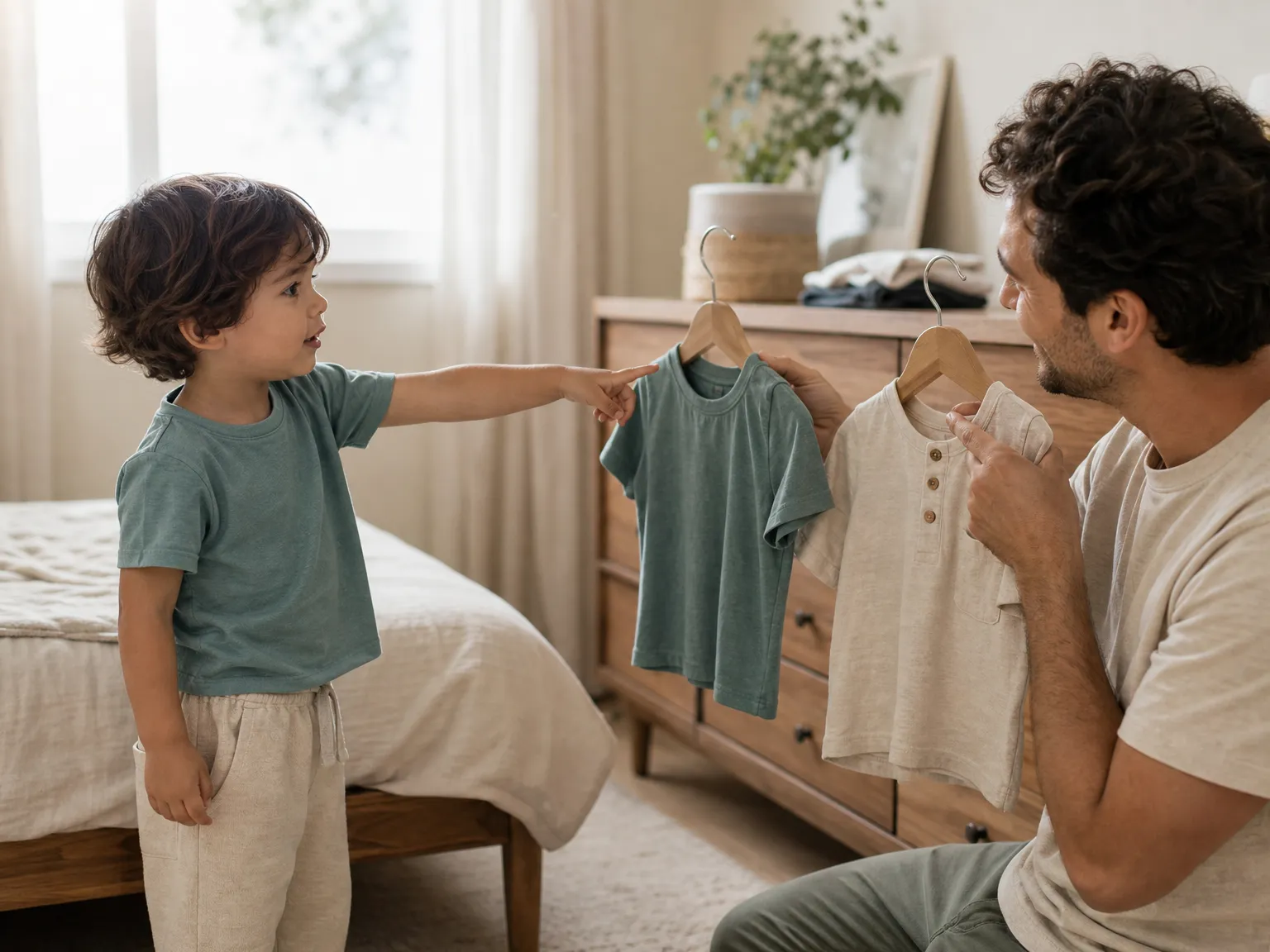
Short answer: Offer two clothes you can accept, then help with one small dressing step. Keep necessities such as warmth and clean clothes clear, while letting your child decide something real, such as which suitable shirt to wear. If they reject both, check for discomfort or a task that feels too hard before offering more options.
This guide is for everyday dressing struggles with children roughly ages 2–6. A toddler may choose a shirt and still need you to put it on; an older child may manage most of the task independently. The goal is room for your child’s preferences within what the day requires, not a promise that every morning will go smoothly. If your child is ill, in pain, or distressed by a particular garment, attend to that need first.
Decide what is fixed and what your child can choose
Before bringing out clothes, ask yourself: What does my child actually need to wear today? A cold or wet trip may call for weather protection. Childcare or school may require specific clothing. Clean underwear may be nonnegotiable. The color of a suitable top, the order of putting on socks and shirt, or whether your child pulls up their own trousers may be flexible.
Put out two options you are genuinely willing to use. “The blue shirt or the green shirt?” is a choice; “Will you get dressed?” sounds optional when you have to leave. The CDC’s guidance for parents of toddlers and preschoolers uses two pairs of pants as its dressing example and advises clear, age-appropriate directions, one at a time. Two acceptable choices leave less to sort through than an open wardrobe.
Make the options workable, not just visually different. If one shirt scratches, does not fit, or is wrong for the weather, it is not a fair choice. If a specific coat is needed, say so and offer choice in a different part of the process: “The coat is for outside. Would you like to put on your shoes first, or shall I help with the coat first?” Do not offer an unsafe or unsuitable option to end an argument.
Set up a small decision before the rush
On a calmer evening, invite your child to pick between two suitable outfits for the next day. Place the chosen one where they dress. In the morning, the decision is already made; your child can help carry it out. The American Academy of Pediatrics (AAP) suggests laying out clothes the night before for children ages 4–6 so the morning can focus on dressing. Chesterfield Royal Hospital’s children’s occupational therapy guide suggests practising difficult dressing steps away from time pressure.
You need only a clear space and the clothes your child already has. If the next day changes, such as rain arriving overnight, explain the change and make a new small choice from clothes that fit the conditions. A child can be disappointed that yesterday’s choice no longer works. Acknowledge it without reopening the entire wardrobe: “You chose the light shoes last night. It is raining now. These boots or these waterproof shoes will keep your feet dry.”
If mornings are difficult beyond getting dressed, our guide to simplifying the morning routine helps you decide which other steps to prepare in advance. For this dressing problem, start with the clothes and one next action.
Give the choice, then offer the smallest useful help
Come close enough that your child can see the two items. State the plan briefly: “We need clothes before we go. Blue shirt or green shirt?” Give them a chance to point or answer. Once they choose, move to the first action: “Let’s put an arm in this sleeve.” If they want to try alone, let them try while you stay nearby; if they ask for help, help with the part that is hard.
The Chesterfield Royal Hospital dressing guide recommends breaking dressing into manageable steps, choosing clothes with some room and stretch, and practising away from time pressure. A loose shirt, elastic waist, or shoes your child can manage can make a genuine choice easier to carry out. Help with difficult fastenings now; practise zips and buttons later, when the family is not trying to get out the door.
Here is one way the conversation might go:
Child: “I’m not wearing that shirt.”
Parent: “That one doesn’t feel right. Here are two other shirts that work today: the soft blue one or the green one.”
Child: “Blue. But I can’t do it.”
Parent: “You choose blue. I’ll hold the neck open. You can put one arm through, or I can help.”
This is an example, not a script that guarantees cooperation. The parent’s job is to keep the necessary clothing boundary, notice a possible problem, and offer help without turning every button into a contest.
What if your child says “neither”?
Resist the urge to produce six more shirts. Ask one useful question: “Is it the way these feel, or do you want to keep playing?” You may learn that a seam rubs, a sleeve is tight, your child wants to finish a game, or dressing itself feels difficult. Fix a concrete problem if you can. If both shirts are uncomfortable, replace them with comfortable, suitable clothes rather than insisting that the original choice be honored.
If your child is simply not ready to engage, name the next step and offer help: “We still need to get dressed. I’ll set the shirt here. Do you want to start with your arm, or would you like me to help?” If the child cannot answer, stay calm and help with the necessary caregiving, then revisit the choice at a less rushed time. For a child who is upset, fewer words and one item at a time may be more useful than another explanation. The CDC advises a calm voice and one direction at a time for toddlers and preschoolers; inability to do a task should not be mistaken for refusal.
Do not make warmth, hygiene, or a required uniform sound negotiable when it is not. Equally, avoid forcing a painful garment when a suitable alternative exists. If time is running out, you can do more of the dressing while preserving a small choice, such as which sock goes on first. Later, ask what made that moment hard and adjust tomorrow’s options.
Match the choice to your child’s age and skills
Around 2–3: Hold up two items and accept a point as an answer. Invite one manageable action, such as pushing an arm through a sleeve or pulling up an elastic waistband, while you do the rest. The Chesterfield Royal Hospital age guide describes a typical progression while noting that children differ.
Around 4–6: Let your child choose from a small set of weather-appropriate clothes and do the parts they can manage. If they get stuck, ask which step needs help instead of taking over automatically. The AAP’s independence advice is specifically framed for ages 4–6; even within that range, children may need reminders about the order of steps. If your child wants an outfit you would not have picked but it is comfortable, suitable, and allowed, consider letting that preference stand.
Children with motor difficulties, disabilities, or clothing sensitivities may need different fabrics, extra time, picture prompts, or hands-on help. NHS guidance on dressing skills describes visual prompts and physical help for difficult movements; NHS guidance on clothing sensitivities describes discomfort from fabrics, seams, and labels. Ask what feels or moves badly before treating refusal as a choice alone.
When to ask for help
If dressing repeatedly causes marked distress, clothes seem painful, or movement difficulties affect dressing and other daily activities, discuss the pattern with your pediatrician or usual health professional. Mention which garments and steps are difficult and whether the difficulty occurs elsewhere. They can consider the concern and whether an occupational therapy assessment would be useful. NHS guidance on developmental concerns advises speaking with a health professional when you are concerned about a child’s development and explains that referral to an occupational therapist may be appropriate; this does not mean a dressing struggle alone indicates a disorder.
For tomorrow, choose two comfortable outfits that both meet the day’s needs. Let your child make one real decision, then help them complete the next small step. If both options fail, the useful question is what is making dressing hard, not how many more choices you can offer.
Sources
- American Academy of Pediatrics, “Growing Independence: Tips for Parents of Young Children” — age 4–6 independence, laying out clothes, and guiding dressing steps.
- CDC, “Tips for Giving Directions” — two acceptable clothing choices, clear single directions, and age-appropriate help for toddlers and preschoolers.
- Chesterfield Royal Hospital, “Getting Dressed” — age variation, manageable steps, clothing fit, and practice without time pressure.
- Leeds Community Healthcare NHS, “Motor skill difficulties” — picture prompts and hands-on support for dressing.
- East of England Community Health and Care NHS, “Dressing strategies for sensitive children” — fabric, seam, and label discomfort and clothing adaptations.
- NHS, “Developmental co-ordination disorder (dyspraxia) in children” — when to raise developmental concerns and possible occupational therapy assessment.

Blub Editorial Team
The Blub Editorial Team is the team behind Blub Kids’ science podcasts for children. We base our articles on WHO, AAP and other primary sources, and we check AI-assisted drafts against those sources before publishing. We don’t give medical advice.
How we write our guides →

