





My Child Does Not Want to Sleep Alone: What Can I Do?
Short answer: If your child is afraid to sleep alone, acknowledge the fear, ask what feels difficult, and agree on a simple bedtime plan before nightfall. Use familiar wind-down steps and clear, reassuring words about where you will be. Keep the change manageable; if anxiety is worsening, disrupting daytime life, or leaving your family unable to cope, ask your child’s healthcare professional for help.
This guide is for parents of children aged 2–9 who want help with the moment a parent leaves at bedtime. It is not an infant sleep-training plan or a way to diagnose separation anxiety. You can work on settling with less parental help even if your child shares a bedroom; having a room of their own is not the goal here.
Find out what “don’t leave” means
Choose a quiet daytime moment, rather than starting a long investigation after lights-out. Ask: “Which bit of bedtime feels hard: the dark, being without me, or something else?” Leave space for an answer you did not expect.
A child who wants the landing light on needs a different conversation from one who says, “What if you don’t come back?” If they mention pain, feeling unwell, a frightening event, or something happening at school, address that concern instead of treating everything as bedtime resistance.
Separation anxiety can disrupt sleep in early childhood. The American Academy of Pediatrics’ explanation of separation anxiety and sleep describes a phase beginning in the second half of the first year, often easing around the second birthday. Its advice emphasizes loving, consistent reassurance. That age context matters: it does not establish that a seven-year-old’s bedtime fear is simply the same toddler phase.
For older children, listen for worries beyond the bedroom. The NHS guidance on childhood anxiety describes sleep difficulties, persistent worrying, clinginess and tummy aches among possible signs of anxiety. One difficult bedtime alone does not tell you whether a child has an anxiety disorder.
Make a plan you can actually keep tonight
You do not need a new sleep product. Use your usual bedtime things and, if helpful, a piece of paper to draw the sequence. The following is a practical household template, not a prescribed treatment or a promise of faster sleep.
1. Name the feeling without arguing about it
Try: “Being in bed without me feels worrying tonight. I’m listening.” Avoid “You’re too big for this” or asking your child to prove that their fear is reasonable.
Then give concrete information: “After our book, I’ll be in the living room.” Only describe a plan you can follow. If another caregiver will be there, say so; do not promise that you personally will always be nearby.
2. Keep the wind-down familiar and finite
For a younger child, choose a short sequence such as wash, pajamas, teeth, one book, cuddle and goodnight. Explain its endpoint before starting: “Tonight we’ll read this book, then have our cuddle.”
The NHS sleep guidance for young children recommends a calming, predictable routine, a limit on bedtime activities, and a dim light if needed. It suggests starting the wind-down around 30 minutes before the child usually falls asleep. Its practical sleep tips focus on under-fives; the example here can be simplified or adapted for your family, rather than treated as an exact schedule for every age.
3. Choose one manageable change
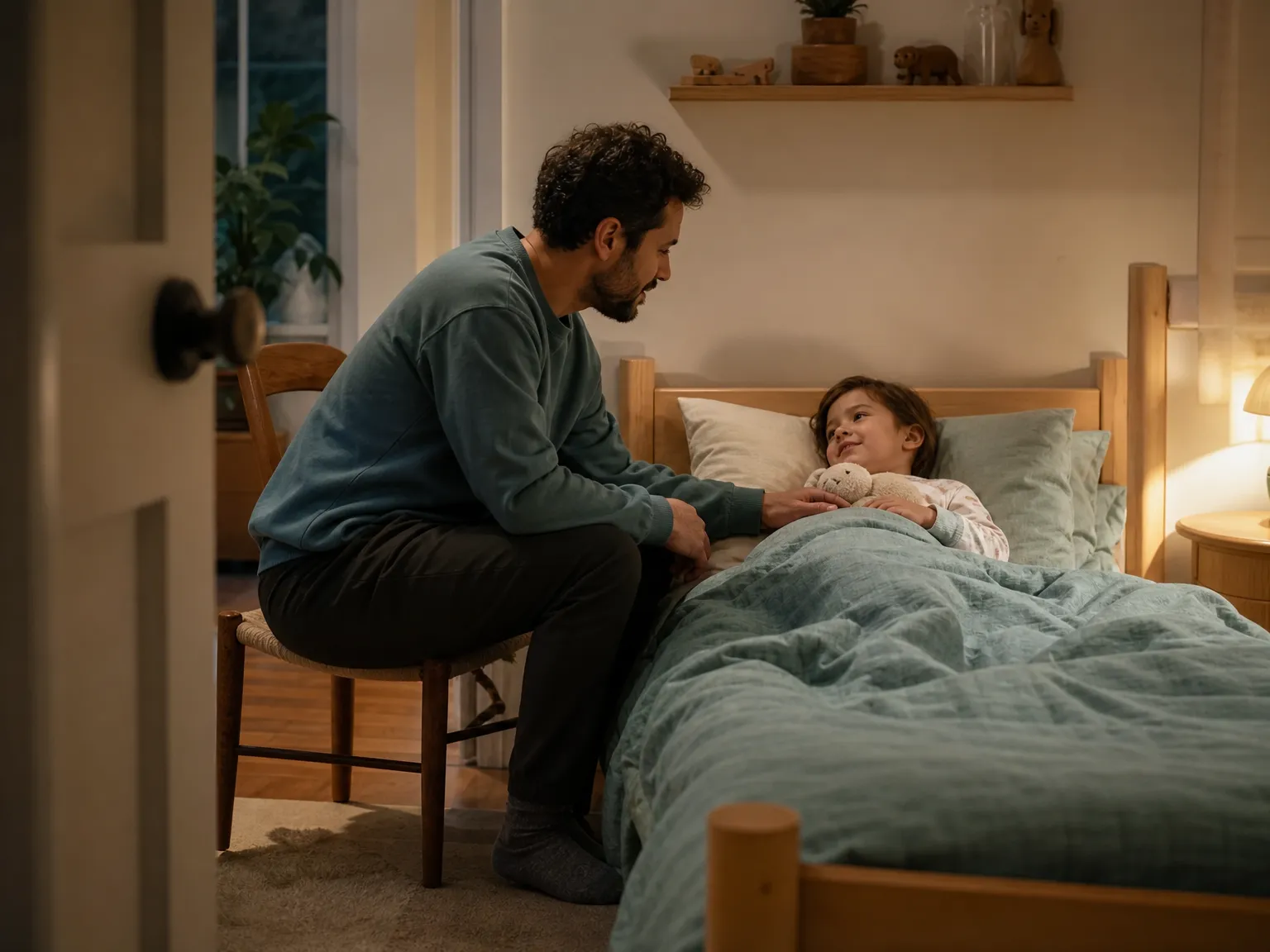
If you currently lie beside your child, discuss a smaller change instead of announcing a completely new arrangement at bedtime. For example: “Tonight I’ll sit in the chair beside your bed after our cuddle.” When that feels manageable, you can discuss the next change together.
This chair example is one way to organize parental support, not a clinically prescribed withdrawal programme. There is no fixed number of nights to advance, and moving farther away while a child becomes increasingly distressed is not the aim. If you need a detailed plan for persistent anxiety, ask for professional guidance.
If your child is comfortable with you leaving, tell them where you are going. If you offer a check-in, make it one you can reliably keep; do not quietly disappear after promising to stay.
4. Agree on the words for a difficult moment
Here is an example conversation with a preschooler:
Child: “You have to stay. I’m scared.”
Parent: “You want me close. Tonight I’m sitting in this chair while you settle.”
Child: “What if it’s too dark?”
Parent: “We can leave the nightlight on. Would you like the door open too?”
Child: “I want another story.”
Parent: “Our story is finished. I can give you a cuddle, then it’s resting time.”
The choices are small and real. You are acknowledging fear while keeping the evening understandable.
5. Respond calmly if they get up
First check whether they need the toilet, feel unwell, or have another immediate need. Then help them return to bed with the same short explanation. The NHS young-child sleep page recommends returning children to bed with little fuss and keeping nighttime interactions low-key.
You can be quiet and reassuring at the same time. If distress keeps rising, pause the planned change and offer support; repeated returns to bed are not a substitute for understanding what is wrong.
Adjust the conversation to your child’s age
Ages 2–3: Use a few concrete words and show what happens next. “Book, cuddle, bed. I’m in the chair.” Offer one simple choice, such as which pajamas to wear. Do not expect a detailed explanation of feelings or apply this plan to a baby.
Ages 4–5: Invite your child to point to or draw the part that feels difficult. A dim light is an option if darkness is the concern. Make a simple picture plan together if they enjoy that; drawing is optional, not a task they must complete before receiving comfort.
Ages 6–9: Ask what they predict will happen when you leave. “Are you worried about being awake on your own, or about something happening to me?” Agree on words and arrangements they find respectful. Persistent fears affecting school, friendships or family life deserve attention, even if your child can sometimes sleep alone.
These are suggested ways to communicate, not milestones children must meet at each birthday. Adapt the language to your child’s understanding and communication needs.
If your child won’t talk or follow the plan
Do not make bedtime depend on answering questions, drawing a fear, or trying a breathing exercise. Say: “You don’t have to explain now. I’ll help you get comfortable, and we can talk tomorrow.”
Keep the familiar routine and choose the easiest support you can sustain that evening. If the chair was too far away, bring it closer and discuss the plan again in daylight. A difficult night is information about what needs adjusting, not a reason to remove reassurance.
The next day, note what happened in plain language: what your child said, what you tried, and whether the worry appears at other times. Share the same plan with other caregivers so your child knows what to expect. Avoid promising a deadline for independent sleep.
When to seek professional help
Contact your pediatrician, GP or another qualified child healthcare professional if worry is not improving, is getting worse, or is affecting school, friendships or family life. These are the NHS’s reasons to seek help for childhood anxiety, along with self-help measures not working.
You can also ask for help when sleep loss is making family life hard to manage; you do not need to wait until you have exhausted every bedtime idea. Bring your brief notes and mention pain, illness, frightening experiences or worries outside bedtime. For children with long-term illnesses or disabilities, the NHS sleep guidance points families toward additional tailored support.
For tonight, choose a familiar routine, one honest reassurance and a manageable level of closeness. Notice attempts your child makes—“You told me what was worrying you”—without making praise depend on falling asleep alone.
Sources
- American Academy of Pediatrics, HealthyChildren.org. Separation Anxiety & Sleeping Trouble in Young Children. Early-childhood age context, disrupted sleep and consistent reassurance.
- NHS. Sleep and young children. Predictable routines, dim lighting, calm returns to bed and additional sleep support; practical tips focus on under-fives.
- NHS. Anxiety disorders in children. Anxiety signs across childhood, impact on daily life and when to seek professional help.
This article is for general information and isn’t medical advice. If you’re worried about your child, talk to your pediatrician.

Blub Editorial Team
The Blub Editorial Team is the team behind Blub Kids’ science podcasts for children. We base our articles on WHO, AAP and other primary sources, and we check AI-assisted drafts against those sources before publishing. We don’t give medical advice.
How we write our guides →

